

The AI Conversation Is Missing the Most Important Variable
Much of the public conversation about artificial intelligence centers on technical skills, automation, and the risk of job displacement. And while these concerns are valid, they may not be the most decisive factor determining who adapts and who falls behind. A growing body of psychological research suggests that the critical differentiator is not whether someone possesses technical expertise today, but whether they believe they can acquire it and influence their current circumstances in the future.
In other words, success in the AI era may depend less on what you know now and more on whether you believe your actions and effort will still matter tomorrow.
The Psychology Behind Feeling Stuck
The concept of learned helplessness originated from experimental research led by Dr. Martin E.P. Seligman at the University of Pennsylvania where he explored how beliefs about control influence behavior. In early studies, subjects exposed to adverse events they could not escape eventually stopped attempting to change their circumstances even when escape later became fully possible. The crucial variable was not the adversity itself but the perceived controllability of the environment. Once the brain encoded the expectation that “nothing I do affects the outcome,” behavior shifted from effort to resignation.
This pattern of cognition does not require trauma to develop. It forms when individuals repeatedly experience situations they interpret as inescapable. Some people, even after difficult events, remain adaptive, resourceful, and hopeful, while others, under similar circumstances, withdraw. The difference lies in how the mind interprets adversity: whether it sees it as temporary or permanent, isolated or pervasive, influenceable or fixed.
Importantly, the experience of helplessness is not what determines future outcomes but the inability to challenge that conclusion does. When a person’s internal narrative states “there is nothing I can do,” effort ceases before any meaningful action is taken.
So What’s the Factor? The Role of Explanatory Style
Learned helplessness is reinforced by what psychologists call explanatory style which is the mental lens through which individuals interpret events. The following three factors shape these interpretations:
- Time: Is this event temporary, or does it mean “this is how it will always be”?
- Scope: Is this challenge specific to this circumstance, or does it “affect everything”?
- Control: Is it possible that “there is something I can do,” or is the outcome entirely “beyond my influence”?
This explanatory style, which is the way you interpret challenge, uncertainty and your ability to influence outcomes, is the psychological factor that most predicts your success in the AI era.
A person with a pessimistic explanatory style views challenges as permanent, pervasive, and uncontrollable, which increases passivity and withdrawal. A person with an optimistic explanatory style frames challenges as temporary, limited in scope, and influenced at least partially by effort, which increases resilience, learning, and action. Crucially, optimism in this context is not blind positivity but cognitive strategy. In clinical settings, this difference altered behavior, and in the workplace, it influences everything from adaptability and initiative to resilience, performance, and overall attitude toward change.
Why Explanatory Style Matters Now in the Age of AI
The rise of AI places the concept of learned helplessness at the center of professional evolution. Technology does not inherently create helplessness but it accelerates exposure to the beliefs that already existed beneath the surface. When individuals perceive technological disruption as inevitable, pervasive, and outside their control, they may disengage long before technology has displaced them.
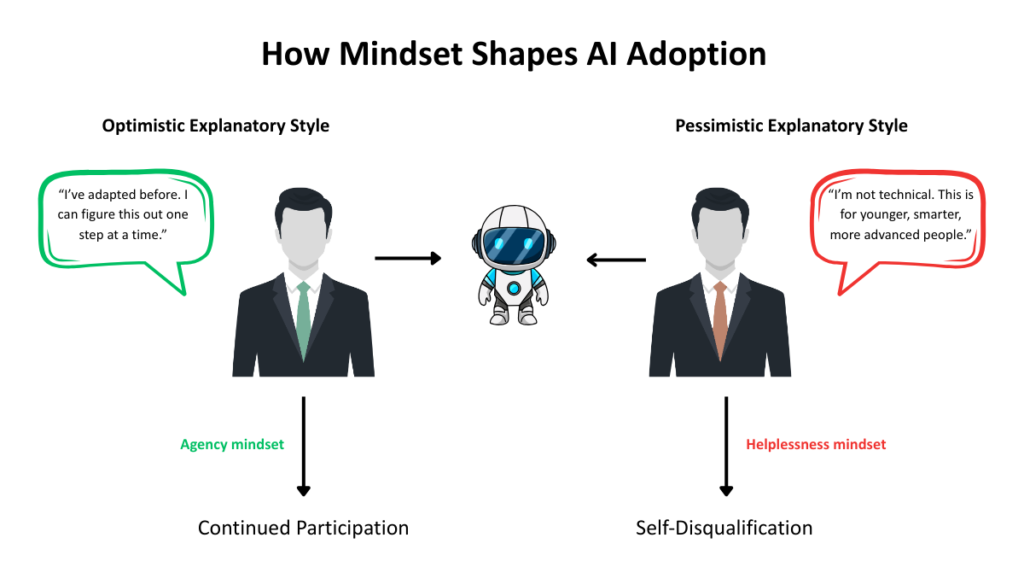
Two professionals may encounter the same software, tool, or change initiative. One responds with curiosity and experimentation while the other withdraws, overwhelmed by the belief that adaptation is beyond reach. The determining factor is not access, age, intelligence, or background but it is whether the person believes that trying still matters. Thus, the future will not divide workers solely by technical skill but by agency which is the conviction that learning is possible and effort is meaningful.
Good News: These Human Skills Still Remain Irreplaceable
AI excels at processing information, recognizing patterns, and generating outputs, but it lacks qualities fundamental to human leadership and decision-making, such as:
- Ethical reasoning
- Empathy
- Contextual judgment
- Presence
- Intuition
- The ability to interpret not only what is being said, but also what remains unsaid
These skills become an advantage only when individuals continue to engage in the environments that require them. Learned helplessness does not eliminate human potential but locks it behind a psychological barrier.
Optimism, Adaptation, and the Trainability of Mindset
The most compelling insight from positive psychology is that explanatory style is modifiable. Individuals can learn to challenge interpretations that assume permanence and powerlessness. Teaching people to realistically dispute pessimistic assumptions has been shown to reduce anxiety and depression while increasing engagement, wellbeing, and resilience. In this context, optimism is not wishful thinking but it is the ability to hold uncertainty without collapsing potential and the willingness to take the next step even when the path is unfamiliar.
Coaching and the Reclamation of Agency
This is where professional coaching aligns with the future of work. It enables individuals to examine the internal stories that shape external behavior, to separate past experiences from present and future possibilities, and to rebuild a sense of influence over their trajectory. It supports the development of resilience, adaptability, and deliberate action which are the qualities that are indispensable in a world defined by continuous change.
And while AI may redefine tasks, individuals redefine whether they remain part of the evolution and whether they approach that evolution with resignation or with agency.
Conclusion: The Future Belongs to Those Who Continue to Try
The most significant risk in the age of AI is not that individuals lack capability, but that they prematurely conclude capability is irrelevant. Learned helplessness silently predicts outcomes because it prevents effort. The story a person tells themselves about their place in the future may determine that future more than technology itself.
Success in the AI era is not reserved for the most technical but it is available to those who retain agency, curiosity, and the belief that action still matters. The question is not whether AI will change work because it already has. The question is whether individuals will maintain the mindset required to engage with that change.
__________________________________________________________________________________________________
Ready to get started with professional coaching?
Click the link below to explore packages:
Maggie Marzec
ICF Certified Executive & Leadership Development Coach